 KH
KH  FR
FR  AR
AR CN
CNAIPA Breaks New Ground as Caucus Holds First Dialogue with Observer Parliaments
AKP Phnom Penh, July 22, 2025 --
The ASEAN Inter-Parliamentary Assembly (AIPA) wrapped up its annual caucus in Phnom Penh last week with inputs from observer parliaments for the first time.
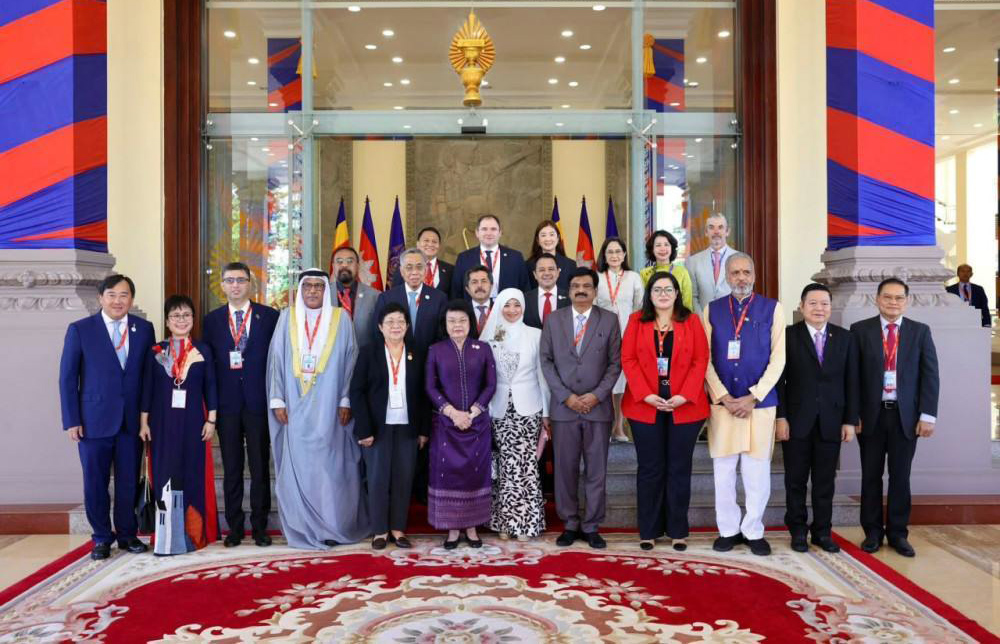
At Cambodia’s initiative, eight observer parliaments took part in the Sixteenth AIPA Caucus hosted by the National Assembly — Azerbaijan, Bahrain, Georgia, India, Morocco, Pakistan and Türkiye, along with the European Parliament.
Among AIPA’s development partners, the Parliamentary Centre for Asia and the International Parliament for Tolerance and Peace (IPTP) also took part.
Timor-Leste — scheduled to become the 11th member of the Association of Southeast Asian Nations later this year — was invited as guest of the chair.
In his welcome remarks on July 15, Hon. Kittisethabindit Cheam Yeap, First Vice-President of the National Assembly, highlighted the participation of observer parliaments and partners as a milestone for AIPA. He welcomed their presence as a sign of commitment to inclusiveness and the rule of law.
PARLIAMENTARY DIALOGUE
AIPA members took part in a parliamentary dialogue with observers the same day.
During the first session — chaired by Hon. Keo Piseth, Secretary of the Commission on Legislation and Justice of the Cambodian National Assembly — observers highlighted the vital role of women parliamentarians in peacebuilding, conflict prevention, and post-conflict recovery through inclusive legislation and leadership.
Observers also recognised the role of parliamentarians in fostering social cohesion and commended AIPA’s engagement in strengthening parliamentary capacities.
In a keynote address to the session, Hon. Ahmed Qarata, Second Deputy Speaker of the Council of Representatives of Bahrain, underscored the importance of convening such a dialogue at a time when the global landscape is fraught with interlinked crises.
He commended AIPA’s growing role as a regional parliamentary platform capable of proposing practical responses to contemporary issues such as climate change, food and water security, technological advancement, and migration.
The Bahraini lawmaker also called for the launch of multi-track regional parliamentary initiatives and greater exchange of legislative expertise.
At the second session — chaired by Hon. Dato’ Ramli Bin Mohd Nor, Deputy Speaker of Malaysia’s House of Representatives — observers highlighted the importance of collective parliamentary action in addressing today’s interconnected risks.
These include climate change, digital disruption, challenges to supply chain resilience, and cybersecurity.
Observers stressed the need to go beyond legislation and oversight to foster regional cooperation, parliamentary diplomacy, and shared solutions that transcend borders.
They recognised climate finance, technology transfer, and digital innovation as essential tools for building sustainable and resilient economies.
The third session was chaired by Hon. Suos Yara, President of the Commission on Foreign Affairs, International Cooperation and Information of the Cambodian National Assembly who is also the current IPTP President.
During this session, observers underscored the importance of enhancing inter-parliamentary cooperation to tackle regional and global peace and security challenges.
They also reaffirmed the importance of upholding international law including sovereignty, non-interference, and the protection of human rights as the legal and moral foundation for peacebuilding.
In highlighting its own experience in contributing to peace and multilateral cooperation, the Cambodian delegation noted the milestone in hosting the 11th Plenary Session of the IPTP last year, which adopted the Universal Peace Charter: For People and the Planet.
Cambodia is now preparing to help operationalise the International Institute for Peace and Justice, as outlined in the Peace Charter
‘A VALUABLE PLATFORM FOR MEANINGFUL EXCHANGE’
The Secretary General of AIPA — H.E. Ar. Siti Rozaimeriyanty Dato Haji Abdul Rahman — described the dialogue as a valuable platform for meaningful exchange among AIPA members and observers.
She stressed that such an initiative built within the AIPA’s mechanism was to enrich perspectives and strengthen the collective commitment to peace, stability, and prosperity.
The Secretary General urged member parliaments to consider similar efforts and invited observers to deepen their engagement with AIPA to ensure more purposeful and effective cooperation.
Established in 2007, the AIPA Caucus aims to be a mechanism to develop common legislative initiatives with the objective of harmonising the laws of ASEAN members.
It also serves as a platform for regular interaction among AIPA members as well as AIPA and ASEAN in monitoring the implementation of resolutions adopted by the AIPA General Assembly.
Malaysia is hosting this year’s General Assembly in Kuala Lumpur in September.
AIPA currently has two dozen member parliaments.
By Sao Da