 KH
KH  FR
FR  AR
AR CN
CNIMF Chief Confident that Emerging Markets Can Weather U.S. Tariff Shocks
AKP Phnom Penh, April 26, 2025 --
The managing director of the International Monetary Fund (IMF) says she’s confident that emerging markets are resilient enough to deal with the U.S. announcement of punitive tariffs against most of its trading partners this month.
“The impact on emerging markets is quite significant,” Kristalina Georgieva told a joint news conference with Saudi Arabian Finance Minister Mohammed Aljadaanin Washington Friday as the weeklong spring meetings of the IMF and World Bank drew to a close.
”We have downgraded growth projections for emerging markets and developing economies,” she said, referring to the IMF’s latest World Economic Outlook released Tuesday.
“What does that mean? It means that some of them would see a significant slowdown in their convergence to higher‑income countries. And they are also seeking ways to overcome the challenges ahead.
‘FANTASTIC IN BUILDING RESILIENCE TO SHOCKS’
“What works for them is emerging markets have been fantastic in building resilience to shocks.
“And when I look at the universe of emerging market economies, quite a number of countries have become more agile in their policymaking, are more mature in how they approach their fiscal and monetary policy.
“That puts them in a better position,” Georgieva said.
“It is like they have gone through multiple periods of being tested and they got immune to shocks to a certain degree,” she added, apparently referring to the Covid pandemic and surge in commodity prices accompanying the war in Ukraine.
‘DON’T RUSH TO PROVIDE FISCAL SUPPORT WILLY‑NILLY’
Georgieva said she expected emerging markets to “look at their policy tools very carefully. We urge them, be very careful with fiscal measures. Don’t rush to provide fiscal support willy‑nilly because you cannot afford to lose fiscal space.
“Have a medium long‑term framework to rebuild this fiscal space,” she said. “One thing emerging markets can do for themselves is, get your own house in order. Pursue reforms relentlessly because this is what makes you stronger.”
LASTING IMPACT EVEN IF SHOCKS RESOLVED
Aljadaan, the Saudi finance minister, agreed that some emerging economies had “little room to maneuver to deal with shocks. And even if these shocks have been resolved, there is some lasting impact.
“The earlier, the faster that these shocks or trade tensions in this context is resolved, the better for everybody,” he said.
“But we are not in a perfect world and things may take time and countries may get an impact.”
ASIA’S EXPOSURE ‘VERY HIGH’
On Thursday, Krishna Srinivasan — director of the IMF’s Asia and Pacific Department — urged economies in the region to trade more with each other, given that some were highly exposed to the American market.
“If you look at the exports of Cambodia to the U.S. as a share of total exports, that's 37 percent. Same thing goes for Vietnam, it's 30 percent. So the exposure to the U.S. in particular is very high,” he said.
“But in general, exposure to global demand is very high.
“On top of that, you see that the tariff fees which are imposed on April 2, are significantly higher for Asia than other parts of the world.
“So those two factors put together, exposure to external demand, and the fact that high tariff rates have slowed prospects across many parts of the region — how should Asia respond?”
INTRA-ASEAN TRADE ‘NATURAL WAY OF DIVERSIFYING YOUR EXPORTS’
Srinivasan highlighted the “greater potential” for increased trade among economies in the region, notably ASEAN members.
“ASEAN intraregional trade is 21 percent. That could be significantly increased. Going beyond the ASEAN, there could also be… greater trade within the region, which could also boost your export dimension,” he said.
Srinivasan noted ASEAN’s position as the world’s fourth-biggest trading block.
“if you take as a block together in terms of GDP, there could be a lot more intraregional trade,” he said.
“So if you have greater trade within the region, that provides you a natural way of diversifying your exports.”
Under the “reciprocal tariffs” unveiled by U.S. President Donald Trump this month — now paused for 90 days — developing ASEAN economies are among the hardest hit.
Cambodia, Laos, Myanmar and Vietnam — the least developed — face levies of more than 40 percent on goods shipped to America.
Thailand and Indonesia are meanwhile dealing with tariffs of 30 percent or more on their merchandise. The least affected are Brunei, Malaysia and the Philippines with tariffs of less than 20 percent.
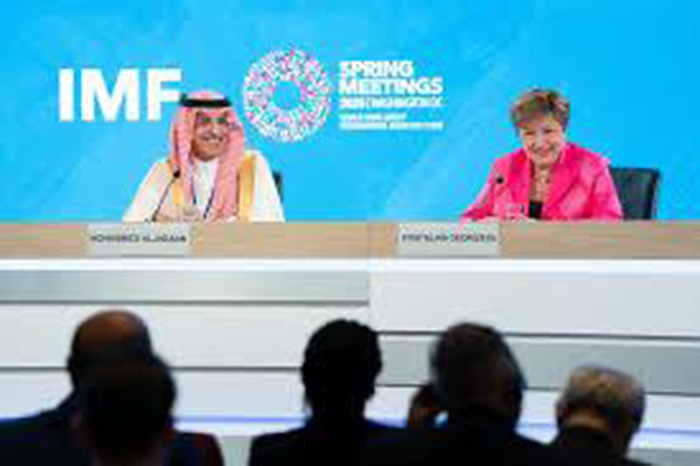
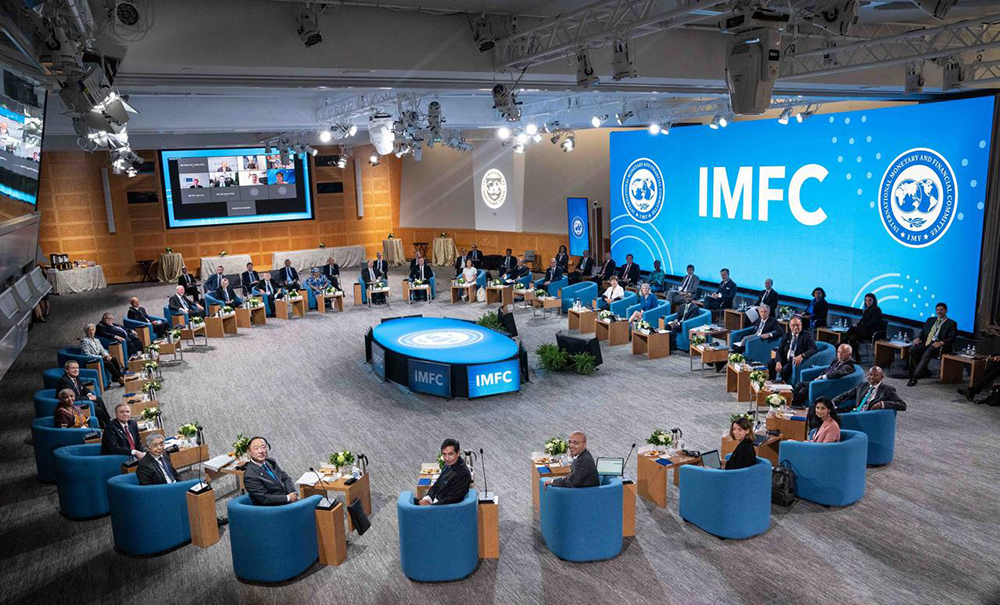
IMF Managing Director Kristalina Georgieva and Saudi Arabian Finance Minister Mohammed Aljadaan co-chair a meeting of the IMF’s International Monetary and Finance Committee in Washington Friday (Photo: IMF)
By Sao Da