 KH
KH  FR
FR  AR
AR CN
CNIMF Downgrades Global Growth Forecasts Amid World Tariff Turmoil
AKP Phnom Penh, April 23, 2025 --
The International Monetary Fund (IMF) has downgraded its growth forecasts for most of the world’s economies including Cambodia following U.S. President Donald Trump’s announcement of punitive tariffs against trading partners.
In its World Economic Outlook released in Washington on Tuesday, the IMF forecast Cambodia’s GDP growth this year at 4.0 percent, down from 5.5 percent projected in October.
Growth next year is now expected to be 3.4 percent, down from the earlier forecast of 5.8 percent.
"Since February, the United States has announced multiple waves of tariffs against trading partners, some of which have invoked countermeasures,” the IMF said.
"Markets first took the announcements mostly in stride, until the United States’ near-universal application of tariffs on April 2, which triggered historic drops in major equity indices and spikes in bond yields, followed by a partial recovery after the pause and additional carve-outs announced on and after April 9.”
‘Potential for further disorderly corrections’
“Despite significant equity market corrections in early March and April, price-to-earnings ratios in the United States remain at elevated levels in historical context, raising concerns about the potential for further disorderly corrections.”
The IMF said it latest forecasts are based on information available up until April 14 — two weeks after Trump’s announcement of “reciprocal tariffs” including 49 percent on imports from Cambodia.
For ASEAN economies apart from Cambodia, slower growth is also forecast with the IMF downgrading the Philippines, Indonesia, Malaysia and Thailand from forecasts contained in an update in January (Cambodia wasn’t included in the update)
The Philippines is expected to be the fastest growing ASEAN economy this year expanding by 5.5 percent followed by Vietnam (5.2 percent), Indonesia (4.7 percent), Malaysia (4.1 percent), Brunei and Laos (both 2.5 percent), Singapore (2.0 percent), Myanmar (1.9 percent) and Thailand (1.8 percent).
Among the other five members of the Regional Comprehensive Economic Partnership (RCEP), China is forecast to record the fastest growth of 4.0 percent followed by Australia (1.6 percent), New Zealand (1.4 percent), South Korea (1.0 percent) and Japan (0.6 percent).
Hong Kong, which is seeking to accede to RCEP — the world’s largest free-trade agreement — is projected to grow by 1.5 percent.
‘DOWNGRADES ARE BROAD-BASED ACROSS COUNTRIES’
For the world economy overall, the IMF now projects growth of 2.8 percent this year, down from 3.3 percent forecast in its January update.
"The downgrades are broad-based across countries and reflect in large part the direct effects of the new trade measures and their indirect effects through trade linkage spillovers, heightened uncertainty, and deteriorating sentiment,” the IMF said.
In a commentary released Tuesday, IMF Economic Counsellor Pierre-Olivier Gourinchas said Trump’s tariffs would be a “negative supply shock” for America with resources redirected towards making less-competitive items.
“We can expect tariffs to decrease competition and innovation and increase rent-seeking, further weighing on the outlook,” he said.
NEGATIVE DEMAND SHOCK FOR U.S. TRADING PARTNERS
“For trading partners, tariffs are mostly a negative demand shock, driving foreign customers away from their products, even if some countries can benefit from the trade diversion.”
Gourinchas, who chaired a news conference announcing the downgrades in Washington Tuesday, warned that dense global supply chains could “magnify the effects of tariffs and uncertainty.
“Most traded goods are intermediate inputs that cross borders multiple times before being turned into final products.
“Disruptions can propagate up and down the global input-output network with potentially large multiplier effects, as we saw during the pandemic.
“Companies facing uncertain market access will likely pause in the near term, reduce investment and cut spending.”
DOLLAR OUTLOOK MIXED
As the tariffing country, the United States “may see its currency appreciate as in previous episodes.
"However, greater policy uncertainty, dimmer U.S. growth prospects, and an adjustment in the global demand for dollar assets — that has so far been orderly — can weigh down on the dollar, as we saw since the tariff announcements.
“In the medium term, the dollar may depreciate in real terms if the tariffs translate into lower productivity in the U.S. tradable goods sector, relative to its trading partners.
NEED FOR ‘CLEAR AND PREDICTABLE TRADING SYSTEM’
While worsening trade tensions could further depress global growth, prospects could “immediately improve if countries ease their current trade policy stance and forge new trade agreements,” the French economist said.
Gourinchas said IMF recommendations called for prudence and improved collaboration.
"The first priority should be to restore trade policy stability and forge mutually beneficial arrangements,” he said.
“The global economy needs a clear and predictable trading system addressing long-standing gaps in international trading rules, including the pervasive use of non-tariff barriers or other trade-distorting measures.
“This will require improved cooperation."
TECHNOLOGICAL PROGRESS AND AUTOMATION
On claims that globalisation has displaced manufacturing jobs in advanced economies, Gourinchas said: "There is some merit to these grievances.”
But “the share of manufacturing employment in advanced economies has been in a secular decline in countries running trade surpluses, like Germany, or deficits, like the United States.
“The deeper force behind this decline is technological progress and automation, not globalisation,” he said.
“Both forces are ultimately beneficial but can be very disruptive to individuals and communities.
“It is a collective responsibility to ensure the right balance between the pace of progress or globalisation and addressing the associated dislocations."
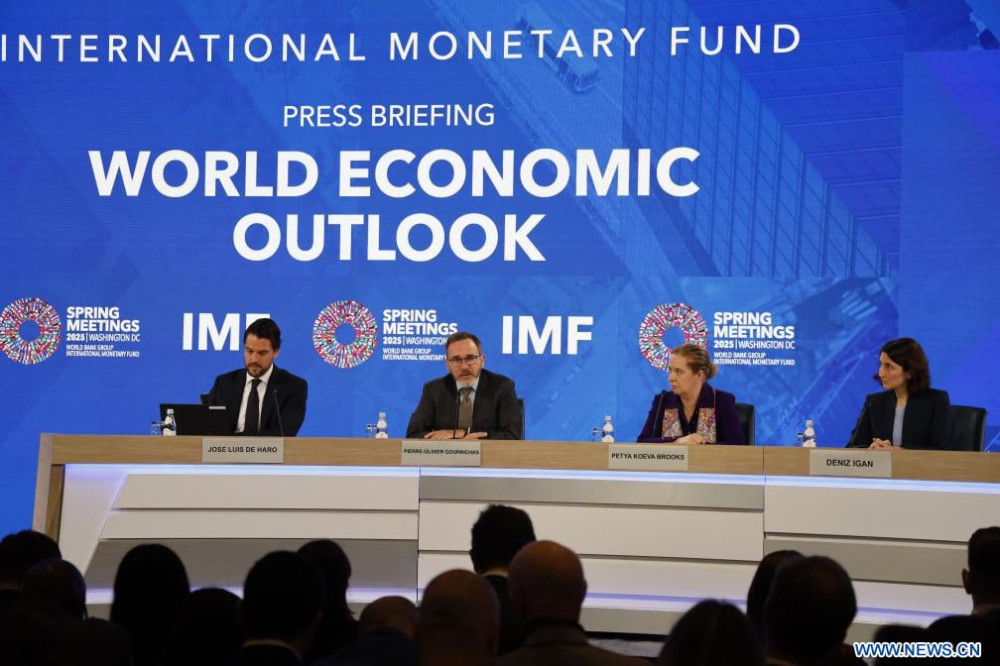
By Sao Da (Photo: Xinhua)